
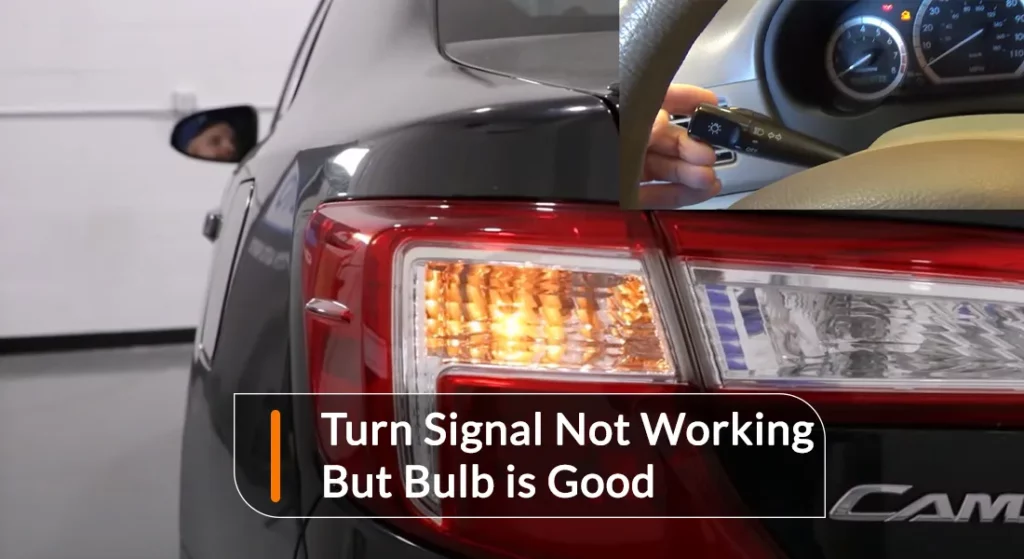
Quick answer: If your turn signal is not working but the bulb is good, the problem is somewhere else in the circuit. The most common causes are a blown fuse, a bad flasher relay, a corroded or loose bulb socket, a bad ground, or a faulty turn signal switch. On newer cars, check the hazard switch and body control module too.
Every vehicle needs working turn signals to warn other drivers before you turn or change lanes. A turn signal that won’t work even though the bulb is good is annoying, and it can be confusing to track down.
Many things can cause this problem, such as a blown fuse or a broken turn signal switch. Some fixes take five minutes. Others take careful troubleshooting.
This article shows the causes of turn signals not working even with a good bulb, how to test each part, and fixes you can do yourself. Check and fix turn signal problems quickly to keep yourself and others safe on the road.
Why Is My Turn Signal Not Working But the Bulb Is Good?
A good bulb only proves the bulb itself is fine. Power still has to get from the fuse, through the flasher, through the switch, into the socket and back out through the ground. A break anywhere in that path stops the signal. How the signal acts gives you a strong clue about where to look.
Here are common signs and what they usually point to:
- Solid turn signal indicator (lights up but does not blink): This usually points to a faulty flasher relay or turn signal switch, not wiring alone.
- Turn signal indicator blinking fast: This usually means a bulb is out on that side, or LED bulbs are drawing too little current for the flasher. A faulty flasher is a less common cause.
- Both light bulbs on one side turn on but do not blink: The cause is usually the flasher relay or the turn signal switch.
- Both the right and left turn indicators don’t work: Check for a blown fuse first, then a bad flasher, corroded sockets or damaged bulbs.
- If all four turn signals come on and stay on when you trigger either side or the hazards: it could be due to a bad flasher unit or a weak electrical system.
- Flashing, whether fast or slow: This is because of a faulty flasher or wiring issues, or Faulty ground connection.
- Also, watch this video to know turn signal problems and ways to make basic diagnoses.
Turn signals are a vital safety device, so any fault should be fixed carefully. If you see any of these signs and can’t find the cause, have a professional technician check your car.
Related Post: Headlights Flashing When Car Is Off:
Turn Signal Symptoms and Likely Causes (Diagnosis Table)
Use this table to match what you see to the most likely cause. Start with the first suspect and work down the list.
| Symptom | Most likely causes | Check first |
|---|---|---|
| Fast blinking (hyperflash) on one side | A bulb out on that side, LED bulbs on a standard flasher, bad socket | All bulbs on that side, front and rear |
| Lights on one side stay solid, no blink | Flasher relay, turn signal switch | Flasher relay |
| Neither side works | Blown fuse, bad flasher, corroded sockets, damaged bulbs | Turn signal fuse |
| Hazards work, turn signals don’t | Turn signal fuse, turn signal switch, hazard switch, separate turn flasher | Fuse diagram for a separate turn signal fuse |
| Slow blinking on one side | A failing bulb on that side, weak ground | Bulbs and ground on that side |
| Signal won’t turn off | Turn signal switch, its cam or the switch assembly | Turn signal switch |
| Dash arrow works, outside lamp doesn’t | Socket, ground or wiring at that lamp, wrong bulb type | Bulb socket |
| Odd behavior only with a trailer hooked up | Trailer wiring or trailer connector | Unplug the trailer and retest |
| Several lights act up at once on a newer car | Body control module (BCM) or network fault | Scan tool for body codes |
The links between symptoms and causes above are based on Wrench’s turn signal troubleshooting guide.
Why Is My Turn Signal Blinking Fast When the Bulb Isn’t Burned Out?
Fast blinking is called hyperflash. It is the car’s way of telling you a bulb is out. If you have checked the bulb and it’s good, look at three things:
- Another bulb on the same side. Each side usually has a front lamp, a rear lamp and sometimes a side marker or mirror lamp. One of the others may be out.
- A bad socket or ground. A good bulb in a corroded socket can’t draw full current, so the flasher acts like the bulb is dead.
- LED bulbs. If you recently swapped to LED bulbs, this is the most likely cause.
Do LED Turn Signal Bulbs Need a Special Flasher Relay?
Often, yes. A factory turn signal relay is built for higher-current halogen bulbs. LEDs draw much less current. When the relay senses that low current, it assumes a bulb has burned out and flashes faster, according to J.W. Speaker.
There are two fixes:
- LED-compatible electronic flasher relay: This relay does not depend on the bulb load, so it flashes at a normal rate with LEDs. It is usually the cleaner fix when your car has a plug-in flasher.
- Load resistors: A resistor is wired in parallel with each LED to add back the missing load. Warning: load resistors run hot. Mount them away from plastic, wiring and other heat-sensitive parts.
If your car has no separate flasher relay (common on newer models, where the body control module runs the signals), the relay swap is not an option. Use load resistors or LED bulbs made for your specific vehicle.
How Do I Know If My Turn Signal Relay or Flasher Is Bad?
A bad flasher relay often shows one of these signs:
- The signals light up but stay solid and don’t blink.
- Neither side works, but the fuse is good.
- The clicking sound from under the dash is missing or irregular.
- The blink rate is wrong even though all bulbs and sockets check out.
The simplest test is a swap. On many cars the hazard flasher and turn signal flasher are the same type of plug-in relay. If you have a known-good matching relay, swap it in. If the signals start working, the old relay was bad.
Why Do My Hazard Lights Work But Not My Turn Signals?
Working hazards prove your bulbs, sockets and most of the wiring to the lamps are fine. The fault is in the part of the circuit only the turn signals use. Check these, in order:
- Turn signal fuse. On many vehicles the hazards and turn signals have separate fuses. A blown turn signal fuse kills the signals but leaves the hazards working.
- Turn signal flasher. Some vehicles use a separate flasher for the hazards and the turn signals.
- Hazard switch. On many cars, turn signal power passes through the hazard switch on its way to the turn signal switch. A worn hazard switch can block the turn signals while the hazards still work.
- Turn signal switch. If everything above checks out, the switch on the steering column is the next suspect.
Dash Indicator Works But the Outside Lamp Doesn’t (and the Reverse)
Dash arrow blinks, outside lamp stays dark: The switch and flasher are doing their job. The problem is at that lamp. Check the socket for corrosion, the ground wire, the wire feeding that lamp, and that you have the right bulb type. The dash arrow may also blink fast because the flasher senses the missing load.
Outside lamps blink, dash arrow doesn’t: The signal circuit works. The fault is in the instrument cluster, such as a failed indicator bulb on older cars, or in the cluster or body control module on newer cars. This is a warning-light problem, not a safety problem for other drivers, but it should still be fixed.
How To Fix Turn Signal Not Working But the Bulb is Good?
There can be various reasons for malfunctions in the turn signal, even if the bulb is good. Here are some possible causes and solutions for turn signals not working even when the bulb is good:
Possible Problems:
- Blown fuse
- Faulty flasher relay
- Damaged or corroded wiring
- Malfunctioning turn signal switch
- Faulty ground connection
- Corroded or loose bulb socket, or the wrong bulb type
- Faulty hazard switch
- Body control module (BCM) or network fault on newer vehicles
- Damaged trailer wiring
Solutions:
- Check and replace the fuse.
- Check and replace the flasher relay.
- Inspect wiring connections and repair or replace damaged wiring as needed.
- Replace the turn signal switch.
- Check and repair the ground connection.
- Clean or repair the bulb socket and confirm the correct bulb type.
- Test the hazard switch, scan the BCM for codes, and unplug any trailer to rule it out.
It’s important to remember that the particular source of the problem might differ based on the vehicle’s make and model. Hence, it is preferable to see a professional technician if you are unclear about the cause or how to make the necessary repairs.
Let us discuss the ways to solve the turn signal issues.
Blown Fuse
Let us discuss the causes and solution of a blown fuse.
Causes:
There might be a few reasons why the fuse blows.
- A short circuit,
- broken wiring,
- or a broken turn signal switch
Any of these can cause the turn signal fuse to blow. A short circuit happens when electricity flows through a path that wasn’t meant for it. This creates too much current and heat, which blows the fuse.
A blown fuse can also be caused by broken wiring, a broken turn signal switch, or a shorted trailer harness drawing too much current. Let’s find out how you can solve it.

Solutions:
- Switch out the fuse: When a turn signal fuse blows, the first thing to do is to replace the old fuse with a new one. Always use a fuse with the same amperage rating. A higher-rated fuse can let wiring overheat.
- Make sure there’s no short circuit: If the new fuse blows as soon as it is put in, there may be a short circuit in the wiring, turn signal switch or trailer wiring. Unplug any trailer first. Then check the wiring harness for signs of damage or wear, and replace any wires that are damaged or have become corroded.
- Find the cause of the overload. A fuse that keeps blowing means something is drawing too much current. Using the signals less will not fix it. Look for pinched or rubbed-through wires, a shorted socket, a failing switch, or extra lights or trailer wiring added to the circuit.
- Get help from a professional: If you don’t know why the turn signal fuse blew or you don’t feel comfortable making electrical repairs, it’s best to call a professional mechanic or electrician for help.
Also, see this video to fix a blown fuse in a step-by-step process.
Can a Blown Fuse Cause Only One Turn Signal to Stop Working?
It depends on your vehicle. Some cars feed both sides from one turn signal fuse, so a blown fuse kills both sides. Others split the left and right sides onto separate fuses, so one blown fuse can stop just one side. Check the fuse box diagram in your owner’s manual to see how your car is wired.
Faulty Flasher Relay
Let us discuss the causes and solutions for faulty flasher relays.
Causes:
There are many things that can go wrong with a flasher relay, such as
- wear and tear over time,
- exposure to heat or moisture,
- or electrical problems.
Over time, the contacts inside the flasher relay can wear out or get rusty, which can make the relay stop working. The relay can also be damaged by heat or moisture, which can cause it to fail.
Electrical problems, like a short circuit or a circuit that is overloaded, can also damage the flasher relay. Let us discuss the solutions.

Solutions:
- Replace the flasher relay: The flasher relay is a small plug-in relay or electronic module. It switches current on and off to make the signals blink and sets the flash rate. If it is broken, the lights may stay solid, blink at the wrong rate, or not come on at all. Putting in a new flasher relay (our pick/ our recommendation) is often the easiest and least expensive fix. If you run LED bulbs, choose an LED-compatible electronic flasher. The old relay is usually located under the dashboard or in or near the fuse box. Unplug it and plug the new one in.
- Check for loose connections: Before you replace the flasher relay, check the turn signal system for any loose connections. Loose connections can cause the turn signals to act up sometimes, like flickering or not blinking at all. Make sure that all of the connections, like the bulbs, sockets, and wiring, are clean and tight.
- Get a new turn signal switch(our pick/ our recommendation) if a new flasher relay does not fix the problem. A switch that won’t make good contact can act just like a bad flasher.
Corroded or Loose Bulb Socket and Wrong Bulb Type
A bulb can test good on the bench and still not light in the car. The socket is often the reason.
- Corroded or burnt socket: Water gets into lamp housings. Green or white crust on the contacts blocks current. Signs of overheating, like melted plastic or darkened contacts, mean the socket should be replaced.
- Weak contact tabs: The small spring contacts inside the socket can lose tension. The bulb sits loose and loses contact, especially over bumps.
- Wrong bulb type: Single-filament and dual-filament bulbs look alike but are not interchangeable. A dual-filament bulb has two contacts on the base; a single-filament bulb has one. The wrong type may not light, may light the wrong function, or may cause odd flashing. Check your owner’s manual for the correct bulb number.
Damaged or Corroded Wiring
Damaged or corroded wiring causes and solutions are given below.
Causes:
- Moisture,
- severe temperatures,
- physical impact, and
- time
Each of these can damage or corrode wire. Moisture may corrode or rust wires, breaking the circuit. High temperatures can break or weaken wire insulation, exposing wires and causing damage. Accidents and impacts can break wires.
Eventually, wear and strain can make wires brittle and break, interrupting the circuit. Wires corrode when exposed to elements, including humidity, heat, dust, chemicals, and moisture. Here are some solutions-
Solution:
- Check the wiring: The first step is to look at the wiring for damage or corrosion that you can see. Look for wires that are sticking out, insulation that is broken or cracked, or signs of rust or corrosion. If there is any damage, the wires that are broken will need to be replaced.
- Replace the damaged wires: If broken wires are found, they will have to be replaced. You can do this by adding a new piece of wire or by replacing the whole wire harness. To make sure the connection works, it is important to use the right gauge wire and connectors.
- Clean corroded connections: If the wiring is corroded, use a wire brush or sandpaper to clean the connections. This will get rid of any corrosion and make the connection better. Use a contact cleaner to get rid of any leftover dust.
Always clean the socket with electrical contact cleaner(our pick/ our recommendation), which can be found at auto parts shops.
- Change the turn signal switch: If the wiring is in good shape and the problem still happens, you may need to change the turn signal switch. The turn signal switch sends the signal to the flasher relay. The flasher relay then turns on the turn signals. If a switch is broken, the light might blink only sometimes or not at all.

Related Post: Understanding The Acura VSA Light (Meaning, Causes and Fixes)
Malfunctioning Turn Signal Switch
There is no connection between the turn signal lever and the turn signal light if the switch malfunctions or breaks. A signal that won’t turn off after a turn is also usually caused by the turn signal switch, its cam or the switch assembly.
Causes
A turn signal switch usually fails because of
- wear and tear over time,
- physical damage, or
- electrical problems.

Solutions:
- Check the turn signal switch: The first step is to look for damage or wear on the turn signal switch. Check for plastic that is broken or cracked, connections that are loose, or signs of rust or corrosion. If there is any damage, the switch will need to be changed.
- Test the switch: Even if the switch looks fine, it should be checked with a multimeter to make sure it is working properly. This will help find any electrical problems that might be the cause of the problem.
- Change the turn signal switch: If the switch is broken, it needs to be changed. To do this, you can take out the old switch and put in a new one. It is important to use the right switch for your car’s make and model when replacing one.
- If it turns out that the multifunction switch is broken, it will need to be replaced. Read the airbag warning below first, then follow these instructions-
Airbag safety warning: The turn signal switch sits on the steering column, right next to the driver’s airbag and its wiring (the clock spring). An airbag can deploy if its circuit is disturbed while powered. Disconnect the negative battery cable, then wait the full time listed in your service manual before touching the column. That wait lets the airbag system’s backup power drain. Never probe airbag connectors (often yellow) with a test light or meter. If your switch removal requires taking off the airbag, consider having a shop do the job.
- Disconnect the battery (negative cable first) and wait the time your service manual specifies.
- Take off the cover(s) to expose the switch.
- Unplug the switch’s wiring harness connector.
- Remove the screws holding the switch to its mounting.
- Pull the switch out of its housing.
- Reverse these steps to install the new switch, then reconnect the battery and test both sides and the hazards.
Faulty Ground Connection
Take a look at the causes and solutions for faulty ground connections.
Causes:
A bad ground connection is often caused by
- corrosion or rust on the grounding wire or terminal,
- connections that are loose or broken, or
- a bad grounding strap.
- Also, if there is more than one ground connection for the turn signals and one of them is broken, it can affect how well the turn signals work as a whole.

Solutions:
To repair your car’s bad ground wiring, you’ll need some basic electrical understanding. Keep in mind that fixing a ground fixes the turn signal only if the ground was the cause.
- You must trace the ground wires to determine which are related to the turn signal. Unscrew the wires, rewire them if necessary, and re-screw them.
- You may also clean up the connection and confirm that the ground connection is correct. Check to see whether the turn signals are now operational.
Faulty Hazard Switch
On many vehicles, the turn signal circuit runs through the hazard switch. When the hazard button is off, its internal contacts pass power to the turn signal switch. If those contacts wear out, the turn signals can fail or act up even though the bulbs, fuse and flasher are fine. Try pressing the hazard button on and off a few times. If the turn signals start working again, the hazard switch is a strong suspect and should be replaced.
Body Control Module (BCM) or CAN-Bus Problems
On many newer vehicles, there is no traditional flasher relay. The turn signal lever sends a request to the body control module, and the BCM flashes the lights. These modules share data over a network called CAN bus. A software glitch, a failing module or a network fault can stop the signals even when every bulb and wire is fine.
- Clues: several lighting functions fail at once, or other body features (locks, wipers, interior lights) act up too.
- Diagnosis: A basic code reader often reads only engine codes. You need a scan tool that can read body (B) and network (U) codes and show the turn signal switch input in live data.
- Fix: Some issues are solved with a software update. A replacement BCM often has to be programmed to your vehicle, which usually means a dealer or a well-equipped shop.
Trailer Wiring Problems
If you tow, the trailer is part of your turn signal circuit. A shorted trailer harness, a corroded plug or a bad trailer ground can blow the fuse, cause fast or erratic flashing, or stop the signals. Unplug the trailer and test your signals. If they work normally, the problem is on the trailer side or in the trailer wiring kit.
How To Test a Turn Signal Bulb and Socket
You need a test light or a digital multimeter. Follow these steps:
- Test the bulb. Set the multimeter to continuity or the lowest ohms setting. Touch one probe to each filament contact on the base and the other to the metal side (for a dual-filament bulb, test each contact). A beep or low reading means the filament is good. No reading means the bulb is bad.
- Inspect the socket. Unplug the connector and look for overheating, corrosion or damage.
- Check for power. Clip the test light to a good ground, turn the ignition on, and switch on the turn signal. Probe the socket’s center contact. The test light should flash in time with the signal.
- Read the result. If the test light stays off, the problem is in the ground or electrical connection, not the bulb.
- Check the ground. Clip the test light to battery positive and probe the socket’s ground contact. The light should come on. If it doesn’t, the socket’s ground path is bad.
- Using a multimeter instead: Set it to DC volts. Put the red probe on the socket’s power contact and the black probe on a good ground. You should see voltage that rises and falls as the signal flashes.
The socket inspection and test light steps follow Wrench’s turn signal diagnosis advice. Do not probe near airbag connectors.
Where Is the Turn Signal Fuse and Flasher Relay Located?
The turn signal flasher relay is usually under the dashboard or in or near the interior fuse box. The location changes a lot between makes and models. To find both parts:
- Open your owner’s manual to the fuses section. It shows each fuse box location and what each fuse controls.
- Check the diagram printed on the inside of the fuse box cover. Look for labels like “TURN,” “HAZ,” “STOP/HAZ” or “FLASHER.”
- Note that many vehicles have two fuse boxes: one under the hood and one inside the cabin.
- To find a flasher by sound, turn on the signal and listen for clicking under the dash. Keep in mind the click on some newer cars is made by the instrument cluster speaker, not a relay.
- If you can’t find a flasher, your car may build it into the hazard switch or the body control module. A service manual or parts catalog for your exact model will confirm it.
Repairing Turn Signal on Your Own
If your car’s indicators aren’t working properly, follow these steps.
Step 1: First, park your vehicle on flat ground and turn off the engine.
Step 2: The second step is to make sure the electrical system is powered up for testing by leaving the ignition in the “on” position but without starting the engine. If you tow, unplug the trailer first.
Step 3: Examine the power distribution center (PDC) or fuse box to make sure no fuses have blown in the system. Use the fuse diagram to find the right fuse.
Step 4: If the turn signal light is not turning on, check the turn signal flasher or relay. A flasher or blinker unit is used in the directional signal system to interrupt the signal and produce the flashing effect.
Step 5: Check each bulb socket for corrosion and power using the test steps above. Confirm each bulb is the correct type.
Step 6: The blinker won’t work if the turn signal switch is broken since the circuit will be shorted or open. Input and output power circuits may be checked using a test light. Check the hazard switch too, since the turn signal circuit often runs through it.
Step 7: If there’s a problem with the module, many lights can stop functioning. On many newer cars, a lighting or body control module turns the lights on and off. Scan it for codes. In such a situation, the module may need to be re-flashed or re-programmed.
How Much Does It Cost To Fix a Turn Signal?
Cost depends on which part failed and on your vehicle. Parts prices and shop labor rates vary widely, so get a quote for your exact make and model. This table shows what drives the cost of each fix.
| Fix | DIY difficulty | What drives the cost |
|---|---|---|
| Fuse | Easy | Low-cost part; no labor if you do it yourself |
| Bulb (correct type) | Easy to moderate | Some lamps need trim or the headlight assembly removed |
| Flasher relay | Easy if plug-in | LED-compatible electronic flashers usually cost more than standard ones |
| Bulb socket or pigtail | Moderate | Part price plus splicing or connector work |
| Wiring or ground repair | Moderate to hard | Mostly labor time to trace the fault |
| Hazard switch | Moderate | Dash trim removal on some models |
| Turn signal / multifunction switch | Moderate to hard | Switch price plus steering column and airbag-area labor |
| Body control module | Shop job | Module price, diagnosis time and programming |
Tip: Always rule out the fuse, flasher, bulbs and sockets before paying for a switch or module. They are the cheapest parts and common causes.
Is It Legal To Drive With a Broken Turn Signal?
Turn signals are required equipment on cars and trucks driven on US roads. A broken signal can get you a ticket or a fix-it order, and it can cause you to fail a state safety inspection where one is required. Rules vary by state, so check your state’s DMV or vehicle code. Fix the problem as soon as you can.
Hand Signals To Use Until It’s Fixed
If you must drive before the repair, use standard hand signals with your left arm out the driver’s window:
- Left turn: arm straight out to the side.
- Right turn: arm out, bent up at the elbow, hand pointing up.
- Slow or stop: arm out, bent down at the elbow, hand pointing down.
Hand signals are hard to see at night and in bad weather. Treat them as a short-term measure only, and give extra space when you turn.
Frequently Asked Questions (FAQs)
Here are some commonly asked questions answered below.
Does each turn signal have its fuse?
It depends on the vehicle. Some cars use one fuse for the whole turn signal circuit. Others split the left and right sides onto separate fuses or share a fuse with the hazards. Many newer vehicles control the signals through the body control module. Check the fuse box diagram in your owner’s manual to see how your car is set up.
How to identify and repair electrical problems in turn signal issues?
Inspect the electrical system and make any necessary repairs. Check the turn signal fuses, plugs, sockets and associated wires. A multimeter and a test light let you check for power, ground and continuity.
Pull the fuse and unplug each plug separately. Check their functionality and replace anything that isn’t up to par. Reconnect the cables. The turn signal switch’s functionality may be verified in this way. If broken, repair or replace it, then confirm the turn signal works on both sides.
What is the cost of repairing turn signals?
The cost depends on which part failed and on your vehicle. A fuse or plug-in flasher relay is usually a low-cost part you can swap yourself. A turn signal switch costs more, and labor goes up when steering column trim and airbag-area parts must be removed. Get a quote for your exact make and model.
Conclusion
A turn signal that won’t work with a good bulb is annoying, but it is usually traceable. Start with the cheap, common causes: fuse, flasher relay, bulb sockets and bulb type. Then move to the ground, hazard switch, turn signal switch and, on newer cars, the body control module.
Regular checks of your lights help you catch these problems early. You can try fixing a broken turn signal on your own, but if you’re having trouble, or the job means working near the steering column airbag, it’s best to call in a professional. Keep in mind that putting off fixing a broken turn signal might endanger everyone on the road.
Related Posts:
- Strong Exhaust Smell When Idling [6 Issues To Look Out For]
- Engine Temp Spikes and then Returns to Normal: Causes and Fixes
- Reasons Why Oil In Coolant Reservoir But Car Not Overheating
- Popping Sound When Turning the Steering Wheel at Slow Speed:
- What Causes Brown Sludge In Radiator And How To Fix It


Leave a Reply