
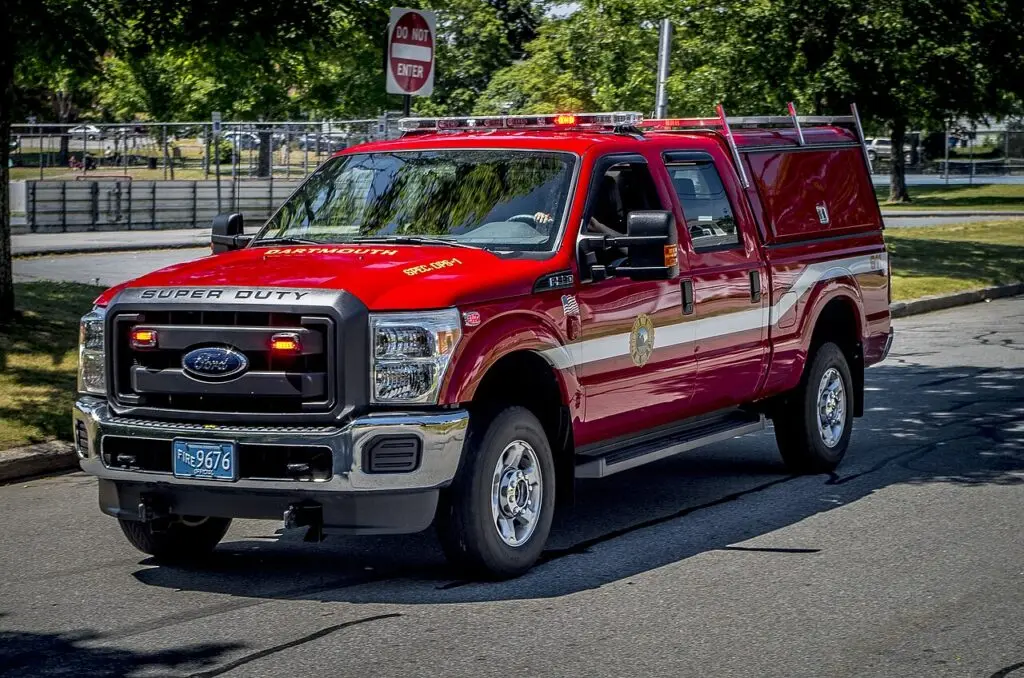
Quick answer: A 6.4 Powerstroke radiator leak usually starts at the seams where the plastic end tanks are crimped to the aluminum core. It affects 2008-2010 Super Duty trucks, and Ford covers it in TSB 11-12-4. The fix is to replace the radiator, update the degas bottle and venturi tee if needed, repair leaking hoses, and refill correctly.
Why does the 6.4 Powerstroke radiator leak?
The factory radiator on 2008-2010 F-Super Duty trucks with the 6.4L tends to leak at the joint between the plastic end tanks and the aluminum core. The core is held to the tanks by metal crimps. When those crimps stretch, the tanks start to separate and coolant seeps out.
Several things add to the problem:
- Stretched crimps. Diesel World reports that the leaks show up at the aluminum-to-plastic seams when the crimps stretch.
- Too much flex up top. Diesel World also points to the upper radiator support, which lets the top of the radiator move too much.
- Low coolant from other leaks. Ford’s TSB 11-12-4 notes that slow leaks at hoses or connections can lower the coolant level. The repeated heating and cooling that follows can crack the radiator tubes.
This is a known design weakness of the truck. A leaking radiator on a 6.4L does not mean the owner did something wrong.
What are the signs of a leaking 6.4L radiator?
The most common sign is coolant residue or wet coolant on the radiator. Ford lists the symptom as an external coolant leak from the radiator, possibly with white dried coolant residue or liquid coolant at hoses and connections.
Watch for these signs:
- White, crusty dried coolant along the end tank seams.
- Wet coolant at the tank seams, hose connections or fittings.
- A coolant puddle under the front of the truck.
- A coolant level in the degas bottle that keeps dropping between top-offs.
Warning: Do not keep driving on low coolant. Per Ford, low coolant leads to thermal cycling that can crack the radiator tubes. A small seep can turn into a bigger failure.
How do you confirm the leak is the radiator and not something else?
Check the radiator seams first, then work outward to the hoses, degas bottle and venturi tee. Do this with the engine cool.
- Inspect both end tanks. Look along the full seam on each side for white crust or wet coolant.
- Check the hose connections. Look at the outside of the upper and lower hose O-ring connections for residue or drips.
- Check the degas bottle. Look for cracks, residue on the bottle, and coolant at the cap sealing surface.
- Confirm the venturi tee is installed. Ford’s bulletin requires checking that it is present and correctly oriented.
- Pressure test (optional). A cooling system pressure tester can help you find slow seeps that are hard to see.
Do not pull the hoses to look inside. Ford says not to remove the upper or lower radiator hoses for leak inspection. White assembly grease inside the hoses can look like a leak and send you the wrong way.
Puddle or no puddle? Diesel World notes that a coolant puddle under the truck is more likely a radiator leak than a head gasket failure. If coolant disappears with no puddle, or shows up in the oil, look at other causes, such as front cover erosion or head gaskets.
What does Ford’s TSB 11-12-4 say about 6.4L radiator leaks?
Yes, there is a TSB for this problem. Ford’s TSB 11-12-4, dated December 22, 2011, covers 2008-2010 F-Super Duty trucks with the 6.4L engine that have radiators leaking coolant externally. It supersedes the earlier TSB 11-6-6.
The repair follows four main steps:
- Inspect the cooling system.
- Install or correct the venturi tee, and update the degas bottle and cap if needed.
- Repair any leaking hoses.
- Replace the radiator.
Which Ford part numbers does the TSB list?
| Part | Ford part number |
|---|---|
| Service radiator | 8C3Z-8009-B |
| Venturi tee | 8C3Z-8B379-B |
| Single-port degas bottle | 9C3Z-8A080-AA |
| Degas bottle cap | 9C3Z-8101-B |
| Upper radiator hose (dual O-ring) | AC3Z-8260-A |
| Lower radiator hose (dual O-ring) | AC3Z-8286-A |
Part numbers can be superseded over time. Confirm the current number with a Ford parts counter using your VIN.
How long does it take to replace a 6.4 Powerstroke radiator?
Ford’s labor times in TSB 11-12-4 range from 2.8 to 3.3 hours, depending on what gets replaced.
| Work performed | Labor time |
|---|---|
| Inspect cooling system and venturi tee, replace radiator | 2.8 hours |
| Same as above, plus replace degas bottle, cap and hoses | 3.3 hours |
These are times for a dealer technician with the right tools. A first-time DIY job will likely take longer.
Is the repair still covered by warranty?
Coverage under the TSB depended on each truck’s warranty status. Most 2008-2010 trucks are now well outside the original warranty, so do not expect a free repair. Ask a Ford dealer about your VIN before assuming anything is covered.
What are the venturi tee and degas bottle updates?
The venturi tee is a fitting Ford added to the 6.4L cooling system. Diesel World describes it as meant to relieve coolant pressure spikes. The TSB requires confirming that the venturi tee (8C3Z-8B379-B) is installed and correctly oriented.
The degas bottle is the plastic coolant reservoir. If your truck has the older dual-port bottle, the TSB says to replace it with the single-port design (9C3Z-8A080-AA) and a new cap (9C3Z-8101-B).
One caution: Diesel World says the venturi tee fix alone did not stop the radiator leaks. Treat these updates as part of the repair, not a replacement for a new radiator.
What are the dual O-ring radiator hoses?
The updated upper and lower radiator hoses use a dual O-ring seal at their connections. Ford lists them as AC3Z-8260-A (upper) and AC3Z-8286-A (lower). Replace them if they are leaking. Do not remove good hoses just to inspect them.
How do you replace a 6.4 Powerstroke radiator?
Here is the high-level process based on Ford’s bulletin. Use the Ford workshop manual for torque specs and detailed removal steps.
- Drain the coolant. Drain the radiator, then remove the engine coolant block plugs on both sides to drain the block, as Ford specifies.
- Replace the radiator. Install the new radiator following the workshop manual.
- Update the degas bottle and cap if needed. Swap a dual-port bottle for the single-port design and new cap.
- Check the venturi tee. Make sure it is installed and oriented correctly.
- Replace leaking hoses. Use the dual O-ring hoses.
- Refill with a vacuum refiller. Then check for leaks and recheck the coolant level.
What coolant does the 6.4 Powerstroke use?
Ford specifies a 50/50 mix of distilled water and new Motorcraft Premium Gold Engine Coolant (VC-7-B). Do not reuse the coolant you drained, even if it looks clean.
Why use a vacuum refiller?
Ford calls for a vacuum refiller, such as the Rotunda Airlift II or an equivalent, to avoid trapped air. The tool pulls a vacuum on the system and then draws coolant in. Trapped air can cause hot spots and false low readings, so this step matters.
Should you use an OEM or an aftermarket aluminum radiator?
Both can work. The choice depends on how long you plan to keep the truck and whether this radiator has already failed before.
| Option | Pros | Cons |
|---|---|---|
| OEM Ford radiator (8C3Z-8009-B) | Matches Ford’s updated parts and the TSB repair. Factory fit. | Still uses plastic end tanks crimped to an aluminum core. |
| All-aluminum aftermarket radiator built for the 6.4L | No plastic-to-aluminum crimp joint, which is the usual failure point. | Fit and quality vary by brand. Not part of Ford’s TSB. |
Diesel World recommends a quality aluminum radiator built for the 6.4L as a longer-term fix.
Decision rule:
- If you plan to keep the truck long term, or you have already replaced the radiator once, consider an all-aluminum unit made for the 6.4L.
- If you want a by-the-book repair with factory parts, use the OEM radiator and the TSB updates.
- Either way, inspect the hoses, degas bottle and venturi tee. A new radiator will not fix a leaking hose or bottle.
Prices change often, so compare current prices from several sellers before you buy.
Can you prevent the 6.4L radiator from leaking again?
You cannot remove every risk, but you can reduce the stress that causes leaks.
- Add a core-support brace. Diesel World suggests one to reduce flex at the top of the radiator and the stress on the joints.
- Keep the coolant level correct. Check the degas bottle regularly. Fix small hose or bottle leaks early so low coolant does not lead to cracked tubes.
- Use the right coolant and refill method. Use the 50/50 Motorcraft Premium Gold mix with distilled water, and refill with a vacuum refiller to avoid trapped air.
Is stop-leak a good idea on a 6.4 Powerstroke?
No, stop-leak is not a good fix for a 6.4L radiator leak. The cooling system also feeds the EGR coolers and other small passages. Anything that seals a leak could also end up in places you do not want it.
Stop-leak also does not address the cause. The problem is a mechanical failure at the tank crimps or in the tubes. Ford’s repair is to replace the radiator, not to seal it. If you need to get home, top off with the correct coolant mix and plan the real repair soon.
Frequently Asked Questions
Which model years have the 6.4 Powerstroke radiator leak problem?
The radiator leak affects 2008-2010 Ford F-Super Duty trucks with the 6.4L Powerstroke engine. Ford’s TSB 11-12-4 covers these trucks when the radiator leaks coolant externally. The usual failure point is the seam where the plastic end tanks are crimped to the aluminum core.
Can I keep driving with a leaking 6.4 Powerstroke radiator?
You should not keep driving on low coolant. Ford notes that low coolant causes thermal cycling that can crack the radiator tubes, so a small seep can become a bigger failure. If you need to get home, top off with the correct 50/50 coolant mix and plan the real repair soon.
Does a coolant puddle mean my 6.4 Powerstroke has a head gasket problem?
A coolant puddle under the truck points more to a radiator leak than a head gasket failure, according to Diesel World. If coolant disappears with no puddle, or shows up in the oil, look at other causes, such as front cover erosion or head gaskets.
Should I remove the radiator hoses to check for a leak?
No. Ford says not to remove the upper or lower radiator hoses for leak inspection. White assembly grease inside the hoses can look like a leak and lead you to the wrong diagnosis. Instead, check the outside of the hose O-ring connections for white residue or drips.
Do I need to replace the radiator hoses when I replace the radiator?
Only if they are leaking. Ford’s TSB says to repair leaking hoses with the updated dual O-ring upper (AC3Z-8260-A) and lower (AC3Z-8286-A) hoses. Do not replace good hoses just to inspect them. A new radiator will not fix a leaking hose, so check each connection carefully.
